4 min read

7 Questions to Ask Before You Buy a Creative Intelligence Tool

7 Questions to Ask Before You Buy a Creative Intelligence Tool
6:47

THE PROBLEM

Every creative intelligence pitch sounds the same

Search for "creative intelligence platform," and the pitches start to blur together. Scoring. Analytics. AI-powered insights. Every vendor uses roughly the same four words to describe roughly the same category of tool.

The differences that actually matter don't show up on a features page. They show up six months into implementation: whether your creative team logs into the tool at all, whether the scoring model reflects your brand's guidelines or someone else's generic best-practice list, whether the data connects back to media spend or dead-ends at a grade nobody acts on.


Rather than a list of vendors and star ratings, here’s a rubric.

Seven questions to run against any tool you're evaluating, plus a scorecard at the end so you can compare answers side by side once the demos are done.

SEVEN KEY QUESTIONS

Seven Key Questions to Help Differentiate These Tools

1

Can you customize the scoring, or is it one-size-fits-all?

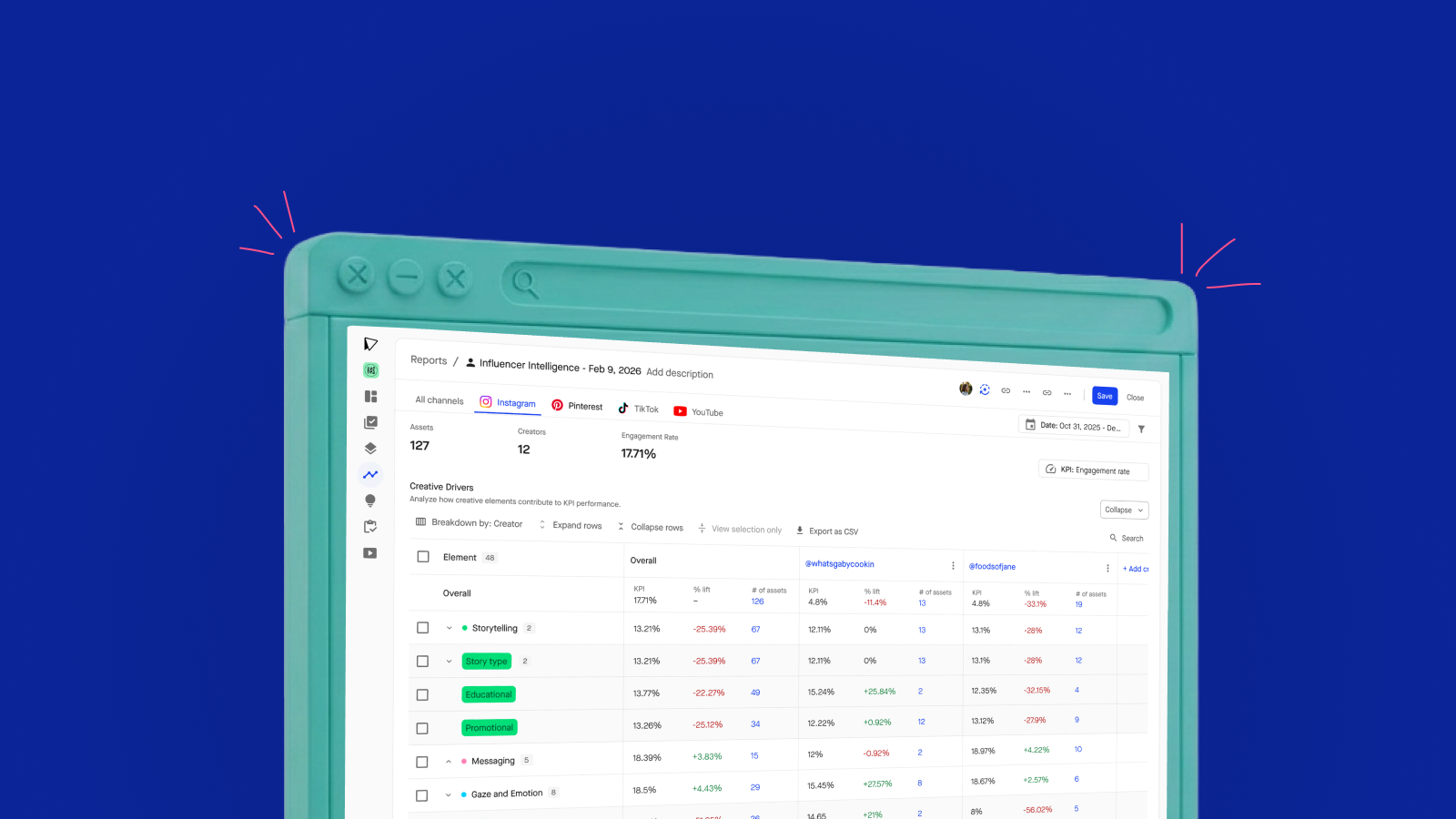
Generic best-practice checklists work fine for a first pass. But a brand with its own visual identity, tone, and category rules needs scoring that reflects that, not a checklist built for the category average. Other questions to ask: can you weight your own guidelines by importance? Can you build custom criteria from scratch, not just toggle a preset list on and off?

2

How many ad platforms does it actually cover?

A tool that scores Meta creative well and stops there leaves gaps everywhere else the media plan runs. Ask for the full integration list, not just the logos on the homepage. Look for direct API integrations across paid social, DSPs, and search Meta, TikTok, Snapchat, Pinterest, Reddit, LinkedIn, Google Ads, DV360, Amazon Ads, and X, at minimum.

3

Does it benchmark against a real norm, or just report numbers in isolation?

A score of "74%" means nothing without context. Ask whether the tool can show how that score compares to your own historical performance, your industry's average, or a specific platform's best practices, and whether that benchmark updates with more data.

4

Does scoring live where creative actually gets made?

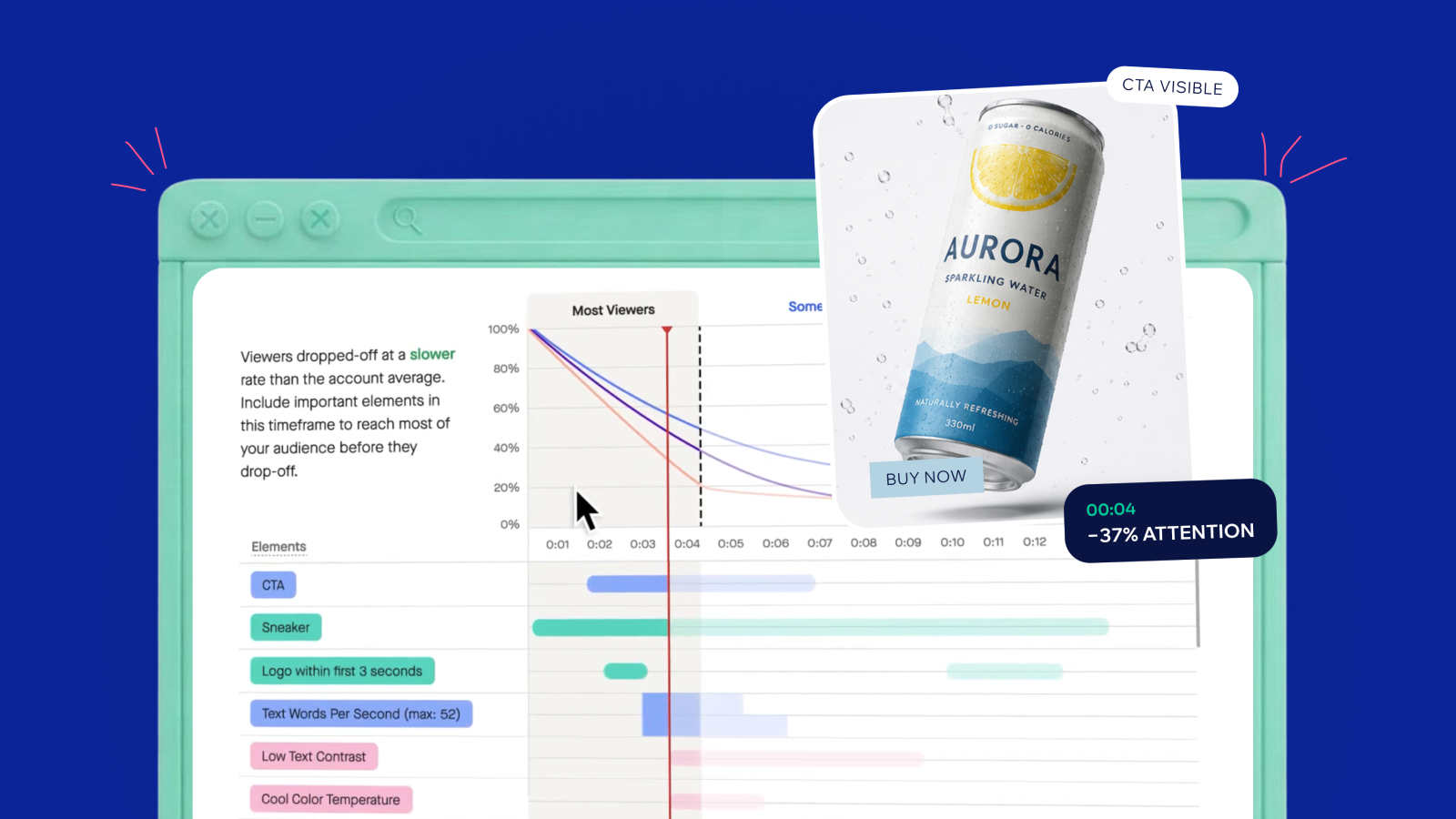
If scoring only happens after an asset is finished, feedback comes too late to change anything. Ask whether the tool has an MCP or an API that plugs directly into production software, so a creator can check an asset against brand guidelines while still building it, not after it ships to review.

5

Can you get your own data out?

Your creative performance data shouldn't be locked inside one vendor's dashboard. Ask whether the platform offers scheduled data exports, a documented API, or MCP access so your own BI tools, AI assistants, production tools, and measurement systems can pull from it directly.

6

How long does it take a non-analyst to get an answer?

If every question requires a request to the data team, the tool won't get used enough to matter. Ask to see how someone without analytics training gets an answer: through a natural-language query, a pre-built executive dashboard, or something else that doesn't require SQL.

7

Does it connect to media ROI, or stop at a creative grade?

A high creative score is not the same as proof the creative is worth the media spend behind it. Ask whether the tool can show which assets are winning at the media level where spend is being wasted on low-adhering creative, and where reallocating it would improve return.

See It Live

Don't take a vendor's word for any of the above. Ask them to show it live.

  • Pull up a real brand's guideline list and change the weight on one criterion in front of you.
  • Ask them to filter creative performance by a platform you actually spend on, not their best-case example.
  • Ask to see a benchmark comparison, not just a single score.
  • Ask how a creative director with no analytics background would use the tool without help.
  • Ask for an export of raw data, and see how many clicks it takes.
  • Ask them to show media spend tied to creative performance, not just view-through rate in isolation.

If a vendor can't do most of these live, that's the answer.

WHAT IMPLEMENTATION ACTUALLY LOOKS LIKE

Kellanova ran this framework across 10 brands over 13 months

Case studies from vendor websites tend to show best-case results. Here's what a real rollout looked like end to end, across a full enterprise portfolio rather than a single test campaign.

Kellanova ran this framework across 10 brands over 13 months, covering 443 assets and about 9% of total US media investment.

100 to 10 hrs

Setup time per brand

11%

ROI improvement on Meta

13

Months across the brand's actual working library, not a pilot

What changed operationally

  • Setup time dropped from 100 hours to 10 hours per brand, shifting from a team manually writing scoring rules to a model narrowing them down.
  • Creative concept decisions stopped being opinion-based. Choices ran on the brand's own performance data instead.
  • Budgeting started to factor in predictive scores rather than relying on past spend patterns or gut calls.
  • Rewards and internal recognition shifted to include adherence to guidelines, not just output volume.

THE HEADLINE NUMBER

11% ROI improvement on Meta, tied directly to creative that followed the model's guidelines versus creative that didn't.

None of this happened in a pilot with hand-picked assets. It ran across the brand's actual working library, at the scale a Fortune 500 marketing org operates at day-to-day.

SCORECARD TEMPLATE

Fill this in for each tool you evaluate

Score 1 (poor) to 5 (strong) on each row, then compare totals.

Criterion Vendor A Vendor B Vendor C
Custom guideline weighting ? Unclear × No × No
Platform/channel coverage Yes Yes × No
Benchmarking against real norms ? Unclear Yes × No
Embedded in production workflow Yes Yes × No
Data portability (export/API) Yes Yes ? Unclear
Usable without an analyst ? Unclear ? Unclear Yes
Connects to media ROI × No Yes Yes
Total      
 

A tool that scores well across all seven tends to hold up past the first quarter. A tool that scores well on one or two and is thin everywhere else usually turns into a dashboard nobody opens by month four.

SEE HOW VIDMOB STACKS UP

Run this scorecard against Vidmob directly

If you want to run this scorecard against Vidmob directly, Vidmob's team can walk through each of the seven criteria live, using your own brand's creative library instead of a demo account.

Schedule a walkthrough
Everyone Agrees Creative Works. Nobody Can Prove It

5 min read

Everyone Agrees Creative Works. Nobody Can Prove It

THE GAP The gap between belief and proof is where creative budgets get cut Marketers don't need convincing that creative matters. Ask any CMO...

Read More
How Creative Data is Transforming MMM

How Creative Data is Transforming MMM

For years, marketing success has been measured by media spend, reach, and clicks. But what about the actual creative—the element that truly captures...

Read More
Defining a “Renaissance”: The Rise of the Intelligent Creative Movement

Defining a “Renaissance”: The Rise of the Intelligent Creative Movement

This year, VidMob took part in the 2021 Cannes International Festival of Creativity, which was hosted virtually. To introduce viewers to VidMob, we...

Read More