

5 min read

Everyone Agrees Creative Works. Nobody Can Prove It

Everyone Agrees Creative Works. Nobody Can Prove It
8:56

THE GAP

The gap between belief and proof is where creative budgets get cut

Marketers don't need convincing that creative matters. Ask any CMO whether the ad itself drives performance, and they'll say yes. The problem shows up one step later, when someone asks them to prove it.

Most teams have been through this before: a "brand lift" study comes back positive, someone asks what specifically drove the lift, and the honest answer is a shrug. Was it the media plan? The audience? The eight seconds of hook before the product showed up? Nobody isolated it, so no one can defend it in a budget meeting.

71%

of marketers say they're ambitious about creative excellence

37%

believe their organization actually has the capability to do it

56%

of campaign impact comes from creative quality (MAGNA/Yahoo)

47%

of sales impact traced to creative, per Nielsen

Sources: WARC industry whitepaper; MAGNA/Yahoo; Nielsen.


This gap between belief and proof isn't rare. In an industry whitepaper by WARC, 71% of marketers said they were ambitious about delivering creative excellence. Only 37% believed their organization actually had the capabilities to do it. That 34-point gap is where most creative budgets get cut, not because leadership doesn't value creative, but because nobody can show the math.

The good news is that the math exists.

Independent research from MAGNA and Yahoo found that creative quality accounts for 56% of campaign impact, more than media placement. Nielsen's research put creative's contribution to sales at 47%. Creative is already doing more work than most marketing orgs are set up to measure, which means the fix isn't a bigger creative budget, it's a way to see what's actually working inside the budget you have.

This checklist turns "I think it worked" into "here's exactly why it worked" and helps marketers build a repeatable framework to connect creative decisions to business results. Meaning the next budget conversation will start with a number, instead of a guess.

THE FRAMEWORK

Analyze, Model, Improve

Most creative measurement efforts fail for the same reason: they try to score everything at once. A brand pulls in every metric available, every guideline in the style guide, every platform's best-practice list, and ends up with a spreadsheet nobody can act on.

The fix is narrowing before scoring. Here's the framework.

1

Analyze

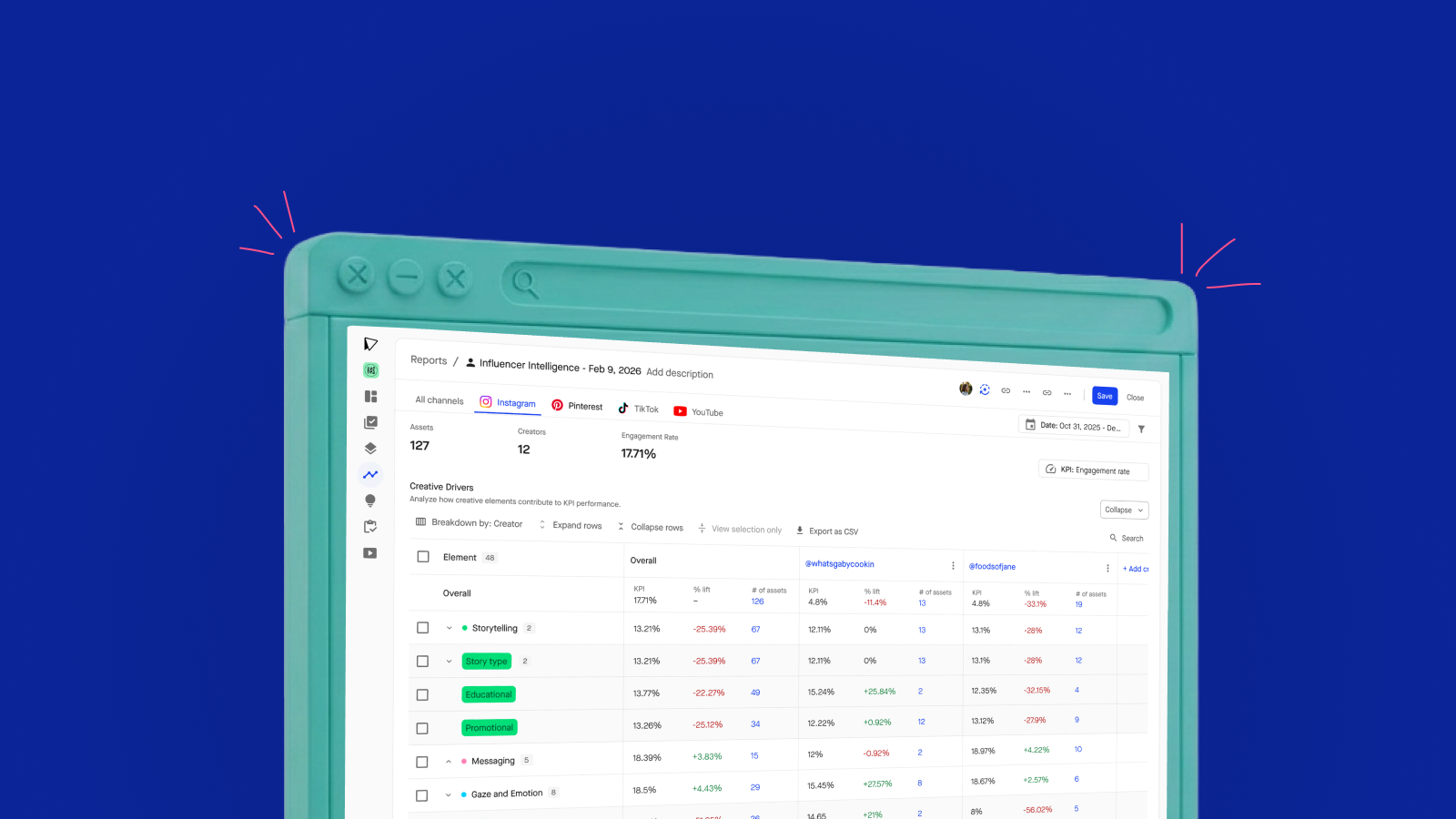
Start with historical creative data, not intuition. Pull the assets that have actually run and look at what they had in common when they performed and when they didn't. In a recent case study, a CPG enterprise ran this analysis across its full library, starting with thousands of possible variables: every visual element, every messaging choice, every structural pattern a creative could contain.

2

Model

Thousands of variables aren't useful. The next step is whittling down to the ones that actually predict outcomes. That same CPG brand cut its list down to 19 variables, then tested each one against real performance. The result: those 19 variables were 83% predictive of 3-second video view-through rate. That's the number that turns a style guide into a scoring model. A way to check a new asset against real evidence before it runs, not after.

3

Improve

A model is only useful if it changes behavior. The last part of the framework is feeding results back into the next round of creative: which guidelines to tighten, which to drop, and how closely adherence needs to be tracked for the lift to show up. This is also where the loop pays for itself in time. The same brand cut the hours needed to build its scoring rules from 100 hours down to 10, a tenfold reduction, because the model does the narrowing that used to take a team a week.

Run this check enough times and creative choice stops being a debate of opinions in a room. It becomes a decision backed by the brand's own performance history.

THE MATH

The Adherence Number Finance Actually Believes

Once a model exists, the next question is what it's worth in dollars. Here's a simple version of the math, using a real example.

A CPG enterprise applied its predictive scoring model to 36 brand assets running in April. The assets that followed the model's guidelines saw 3-second video view-through rates 2.16x higher than assets that didn't. Those assets represented about 9% of the brand's total US media investment. Applied against that spend, the adherence lift worked out to an 11% improvement in profit ROI on the media those assets ran against.

This formula is straightforward:

Adherence rate
Predicted performance lift
Media dollars affected
ROI impact
1

Start with your adherence rate

What percentage of your current creative library follows your top predictive guidelines?

2

Apply your model's predicted lift

If adherent creative outperforms non-adherent creative by a known margin, that margin is your lift.

3

Multiply by the media dollars behind that creative

Lift only matters in proportion to the spend it touches.

4

Express the result as ROI, not just VTR

A performance metric convinces a creative director. A profit number convinces a CFO.

This same structure works whether the brand is running 30 assets or 3,000. What scales is the discipline of tying every creative decision back to a dollar figure before defending it in a budget review.

THE RESULTS

What This Looked Like Across 10 Brands

The numbers above weren't just spun up. Kellanova ran this framework across 10 brands over 13 months, from March 2024 to March 2025, covering 443 assets and roughly 9% of its total US media investment.

83%

Predictive accuracy between the 19 identified creative criteria and 3-second view-through rate

11%

Profit ROI improvement on Meta, tied directly to guideline adherence

100 to 10 hrs

A tenfold drop in the hours required to build scoring rules for each brand

2.16x

Higher view-through rate on assets that followed the model's guidelines versus those that didn't

What changed inside the organization was arguably more important than any single metric. Creative decisions were no longer made from gut instincts, but from a data-backed framework. Budgeting decisions began factoring in predictive scores, and because the scoring covered the brand's entire creative portfolio rather than a handful of test assets, the results held up at the scale a Fortune 500 marketing organization actually operates.

BEFORE YOU BUY

What to Ask Before You Buy a Creative Intelligence Tool

If you're evaluating tools to run this kind of framework internally, a few questions separate the ones that will hold up from the ones that won't:

1

Does it use your brand's own performance history, or generic industry benchmarks?

A model built only on outside data can't account for what's specific to your audience or category.

2

Can it isolate creative's contribution from media and audience factors?

If a tool only reports overall campaign lift, you still can't answer "was this the creative or the targeting?"

3

Does it narrow variables, or just report on all of them?

A dashboard that shows a thousand metrics is not the same as a model that tells you which 19 matter.

4

Does it complement your media mix models (MMM), or compete with them?

A tool that plugs into MMM output can push the cross-channel analysis a level deeper, telling you why the creative worked in one of those channels.

5

Can scores update as new creative runs?

A static rulebook goes stale. A model should tighten as more data comes in.

6

Does it integrate with the channels you actually spend on?

A tool that only covers one platform will leave gaps in a media plan that spans a dozen.

7

Can someone outside the data science team use it?

If it takes an analyst to interpret every report, it won't get used often enough to change creative decisions.

WHERE TO GO FROM HERE

See what this looks like against your own creative assets

The gap between believing creative matters and proving that it does isn't a data problem — most brands already have the historical creative and performance data sitting in their ad accounts. What's missing is a model that can isolate which creative decisions actually drove the result, and a loop that keeps testing that answer against what happens next.

If you want to see what this looks like against your own creative assets, Vidmob's team can walk through the analysis using your brand's existing data.

See the analysis
7 Questions to Ask Before You Buy a Creative Intelligence Tool

4 min read

7 Questions to Ask Before You Buy a Creative Intelligence Tool

THE PROBLEM Every creative intelligence pitch sounds the same Search for "creative intelligence platform," and the pitches start to blur...

Read More
How Creative Data is Transforming MMM

How Creative Data is Transforming MMM

For years, marketing success has been measured by media spend, reach, and clicks. But what about the actual creative—the element that truly captures...

Read More